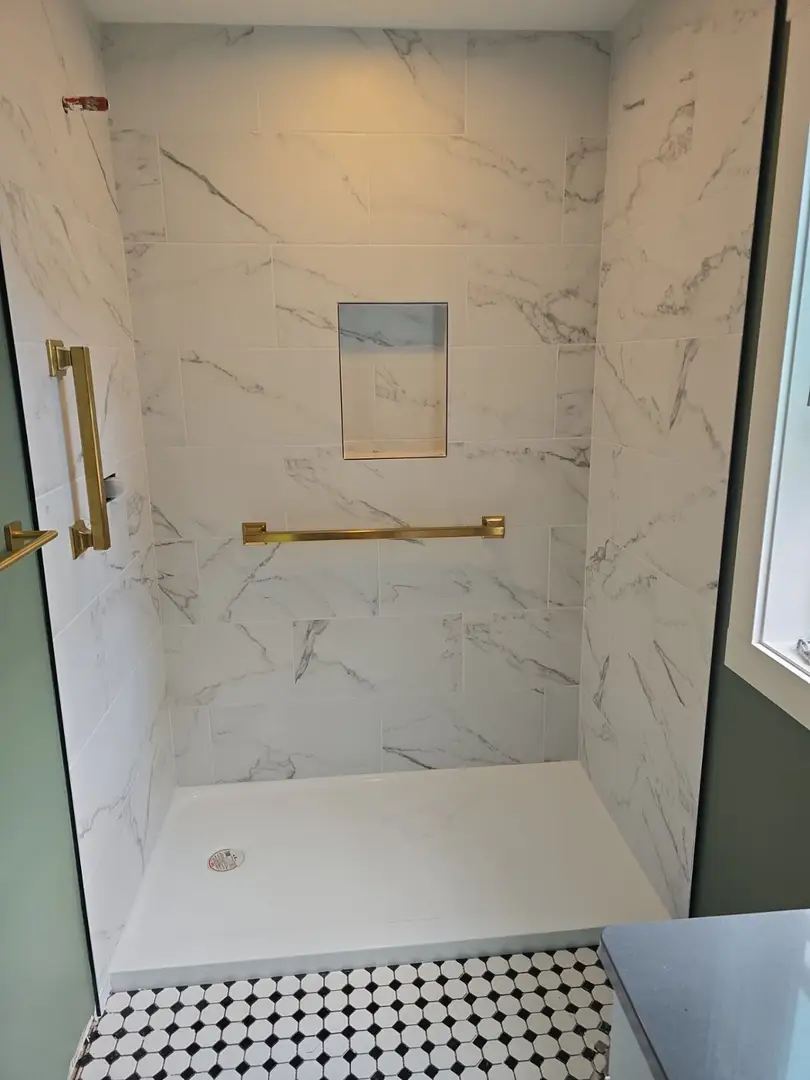
The Tile Is Only The Part You See
A finished shower draws attention to the tile, grout, niche, fixtures, and glass, but the visible finish is only the last layer of a larger system.
A shower deals with repeated water exposure, movement, penetrations, corners, changes of plane, and transitions into the rest of the bathroom. If the work behind the tile is not sound, an expensive finish cannot make the assembly reliable.
A lasting shower tile installation starts before the first piece is set.
The Existing Condition Has To Be Understood
Remodeling an existing shower can reveal several generations of work.
There may be old backer material, previous patches, moisture damage, framing that is not straight, a floor that is not ready for the new assembly, or plumbing locations that affect the layout. Some of those conditions are obvious during demolition. Others only become clear once more of the shower is opened.
The right response is not to hurry through preparation so tile can start sooner. The condition underneath needs to be suitable for the new system.
If damaged material, movement, or moisture is present, that needs to be addressed before the finish layer covers it again.
Water Management Is Part Of The Shower, Not Part Of The Grout
Grout joints are visible, so homeowners sometimes assume that keeping grout sealed is what keeps water out of the wall or floor.
A properly planned shower does not depend on grout as its only defense against moisture.
The assembly needs a water-management approach appropriate for the shower before the tile is installed. That includes how the walls, floor, corners, penetrations, niches, and changes of plane are handled.
The exact products and methods vary, but the principle does not: the waterproofing strategy belongs in the assembly, not as an afterthought applied to the face of the tile.
Flat And Straight Surfaces Make The Finish Better
Tile follows the surface beneath it.
If the wall bows, a corner wanders, or the substrate has large variations, the installer has fewer good options once the tile is going on. Larger tile makes those variations especially visible because each piece spans more of the wall.
Preparation gives the layout a better starting point.
It also helps the tile meet other parts of the shower cleanly. Glass, niches, plumbing trim, benches, ceilings, and outside corners all look better when the surfaces they connect to were considered before installation began.
Layout Should Be Planned Around The Whole Shower
A shower has too many interruptions to choose a starting point casually.
The layout needs to account for the floor, walls, corners, niche, plumbing fixtures, valve, showerhead, bench if there is one, glass location, exposed edges, and the transition out of the shower.
A layout can look balanced in the middle of a wall and still create an awkward sliver at the edge. Moving the starting point slightly can sometimes improve several cuts at once.
Perfect mathematical symmetry is less important than making the important lines, edges, and cuts look deliberate.
Niches Need To Be Part Of The Layout
A niche is a useful storage feature, but it is also a place where several tile details come together.
Its location affects the surrounding grout lines. Its dimensions affect cuts. The inside corners, sill, edges, and water-management details all matter.
If the niche is framed without considering the tile size, the installer may be forced into awkward cuts that could have been avoided.
Planning the niche with the tile in mind usually leads to a cleaner result.
The Shower Floor Has Different Requirements
The shower floor needs to move water toward the drain while still providing a usable surface underfoot.
That slope changes which tile sizes and layouts make sense. Small mosaics are common because they can follow the shape of the floor more easily, but other approaches may work depending on the shower design and drain.
A shower floor is not another flat tiled surface.
The drain location, slope, tile size, grout joints, perimeter, and transition into the rest of the bathroom all have to work together.
Edges And Changes Of Plane Need Deliberate Details
The places where one surface ends are often where quality is easiest to see.
A shower may have an outside corner, a tile-to-drywall transition, a niche edge, a threshold, a bench, or the edge where glass will eventually sit. Those details need a plan before installation reaches them.
Changes of plane also deserve attention. The joint where a wall meets another wall or the floor moves differently than a field of tile across one flat surface.
Treating every joint exactly the same can create problems later.
Plumbing Penetrations Should Look Intentional
Valves, showerheads, body sprays, tub spouts, and other plumbing penetrations interrupt the tile field.
The openings need to be located accurately and cut cleanly enough that the plumbing trim covers them as intended. When the layout is planned early, those penetrations can also be coordinated with grout lines and focal areas.
These are small details, but they are visible every time the shower is used.
Grout Choice Still Matters
Grout is not the shower's waterproofing system, but it is still an important finish material.
Color changes how strongly the tile pattern reads. Joint width affects the overall appearance. Maintenance characteristics matter in a wet environment.
The grout should be chosen with the tile and layout rather than treated as a last-minute decision after the installation is nearly complete.
A contrast color can highlight every joint. A closer color can make the tile field feel quieter. Both can work when chosen intentionally.
A Lasting Shower Is Built As A System
The most durable shower tile work is not the result of one premium product.
It comes from the relationship between the substrate, water management, surface preparation, layout, tile, edges, penetrations, grout, and transitions.
Shower work needs to be evaluated as a complete assembly instead of a decorative finish installed over whatever happens to be there.
Confidence Remodel handles shower tile, bathroom tile, flooring, niches, and related bathroom remodeling work in South Hill, Puyallup, Tacoma, and surrounding communities. If you are planning a shower project, we can look at the existing condition and talk through what the installation needs before the finish materials go in.
Frequently Asked Questions
Related Service
Tile Installation
See tile installation for showers, floors, backsplashes, walls, and detailed interior finishes.
View Tile Installation →