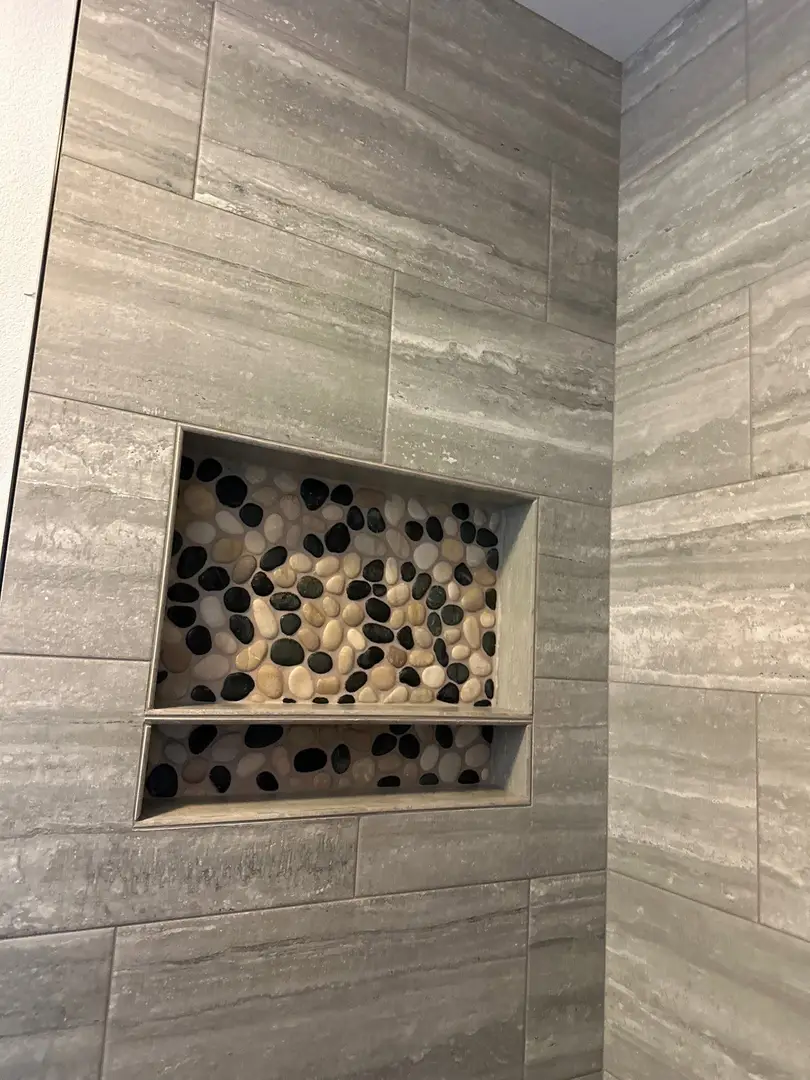
Tile Size Changes The Installation
Large tile and small tile can both produce excellent results, but they do not behave the same way during installation.
A larger piece covers more area at once. That can reduce the number of grout joints and create a cleaner look, but it also means the tile spans more of the surface underneath it. Any bow, dip, twist, or unevenness becomes harder to ignore.
Smaller tile follows changes in the surface more easily, but it creates more joints and more individual pieces that need to stay aligned.
The best format depends on the room, the substrate, the design, and the details the tile has to work around.
Large Tile Makes Surface Preparation More Important
A small tile can sometimes follow minor surface variation that would be obvious under a much larger piece.
Large-format tile needs a surface flat enough for the tile to sit consistently without one edge standing noticeably higher than the next. If the wall or floor is not ready, the installer has fewer ways to correct the problem once setting begins.
The surface does not have to be some imaginary version of perfect. It does need preparation that matches the demands of the tile being installed.
Evaluating that condition before tile starts is much easier than trying to solve it piece by piece during installation.
Handling And Cutting Are Different
A larger piece is heavier, more awkward to move, and more difficult to cut around corners, outlets, plumbing, or other interruptions.
That matters in bathrooms and kitchens where tile rarely covers a completely uninterrupted rectangle.
A large wall tile may need openings for a shower valve and showerhead. A backsplash may need several outlet cuts. A floor can meet door jambs, cabinets, thresholds, and walls that are not perfectly square.
The tile size affects the tools, handling, sequence, and layout needed to make those cuts look intentional.
Smaller Tile Gives More Flexibility
Smaller tile can be useful where the surface changes direction or where a large piece would create difficult cuts.
Shower floors are a good example. The floor needs to slope toward the drain, and smaller pieces can follow that shape more easily. Mosaics can also work around curves, niches, or detailed areas where a large tile would fight the geometry of the space.
The tradeoff is that smaller tile creates more grout joints.
That changes both the appearance and the amount of joint surface that needs to be cleaned and maintained over time.
Grout Lines Change The Visual Scale
Large-format tile generally creates fewer visible grout joints. That can make a wall or floor feel quieter and more continuous.
Smaller tile makes the pattern more prominent because there are more repeated joints across the surface.
Each creates a different look and a different installation problem to solve.
A bathroom with a strong mosaic can feel detailed and intentional. A large tile can make the same room feel simpler and more architectural. The right result depends on the design and how the tile relates to fixtures, cabinets, counters, trim, and nearby surfaces.
Layout Matters More Than The Number On The Box
A tile may technically fit the room while still producing a poor layout.
For example, a very large tile in a small bathroom may leave narrow cuts at both sides of the floor. A smaller tile might produce a better proportion. In another room, large tile might align cleanly with the main sight lines and reduce unnecessary joints.
The only way to know is to plan the layout.
The room dimensions, tile dimensions, grout joints, starting point, focal areas, and edge conditions all matter.
Large Tile Can Make Lippage More Noticeable
When neighboring tile edges are not at the same height, the difference is easier to notice across larger pieces and long straight lines.
Surface preparation, tile shape, layout, and installation technique all influence that result.
This is another reason the work should begin with the substrate rather than assuming the tile itself will flatten the surface.
The cleaner the starting condition, the easier it is to maintain a consistent finished plane.
Shower Walls And Shower Floors May Need Different Formats
It is common to like one tile and want to use it everywhere.
That may work on the shower walls while being less practical on the shower floor.
The floor needs to slope toward the drain, and the tile has to follow that shape. A smaller format can often adapt to the slope more naturally while a larger wall tile creates the cleaner wall appearance the homeowner wants.
Using two tile sizes from the same family can sometimes keep the design consistent while letting each surface use a format better suited to the installation.
Transitions Still Need To Be Solved
Large and small tile both have to meet other materials.
Floor tile may meet carpet, wood, or another hard surface. Wall tile may stop at drywall, cabinets, or trim. Bathroom tile may meet a tub, shower glass, vanity, or threshold.
Tile thickness and the buildup underneath it affect those transitions.
A clean result comes from planning how materials meet before the installer reaches the edge of the room.
Choose Based On The Whole Project
Tile size should not be chosen in isolation.
Look at the surface, the room dimensions, the pattern, the lighting, the cuts, the grout, the transitions, the maintenance you want, and the way the tile will be used.
A large-format product can be an excellent choice when the surface and layout support it. Smaller tile can be the better answer when the space needs flexibility, detail, or a surface that changes direction.
Confidence Remodel installs tile in bathrooms, showers, kitchens, floors, backsplashes, and other interior areas throughout South Hill, Puyallup, Tacoma, and surrounding communities. We can help evaluate the room and installation details before the tile selection becomes a constraint.
Frequently Asked Questions
Related Service
Tile Installation
See tile installation for showers, floors, backsplashes, walls, and detailed interior finishes.
View Tile Installation →